 PDF (Deutsch)
Published
2026-09-08
Issue
Section
Stories
License
Copyright (c) 2026 Francesca Weil

This work is licensed under a Creative Commons Attribution 4.0 International License.
How to Cite
Geflüchtete jüdische Mädchen während der NS-Zeit
Antisemitismuserfahrung, Emanzipation und emotionales Gedächtnis
Francesca Weil
Hannah Arendt Institute for Totalitarinsm Studies
Keywords: Dictatorship Research, Historical Conditions, Emigration
Abstract
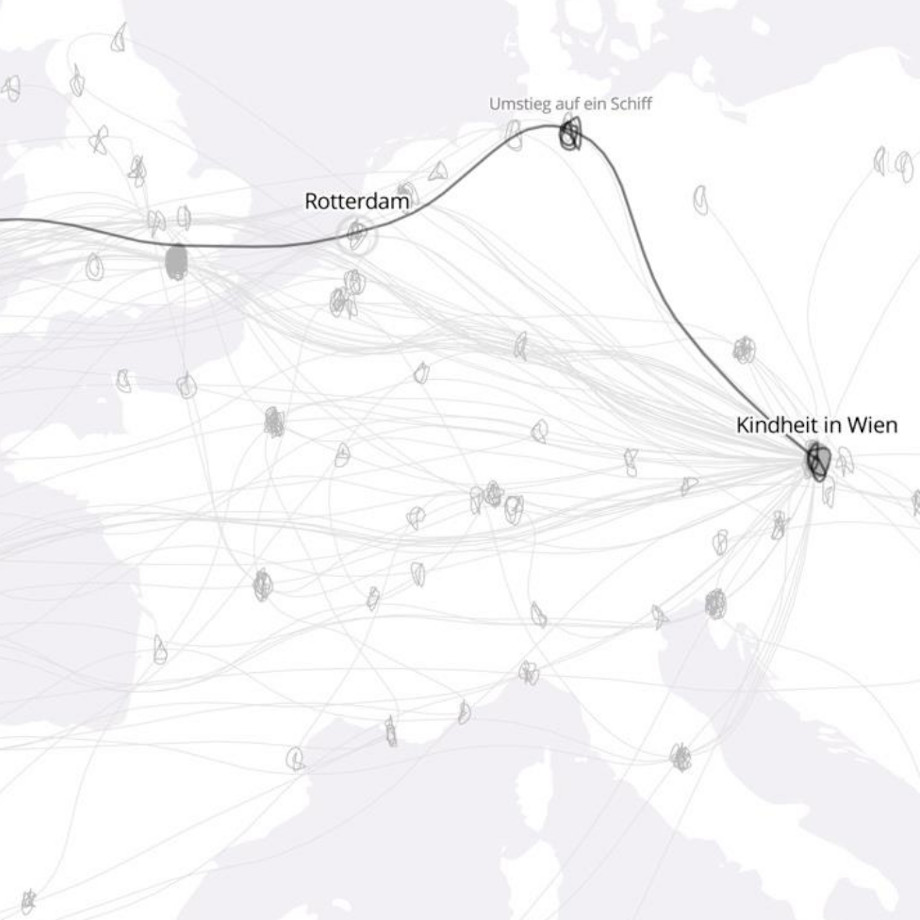
This contribution presents the life story of Vera Woolf (née Altschuler, born in Vienna in 1934), who, as a Jewish child, fled with her family to the United States via Le Havre following the annexation of Austria in 1938. Drawing on her memories of expropriation, expulsion, and the ambivalence of a child’s perception—characterized by a lack of fear despite threatening experiences, as well as by later memories shaped by museums and family narratives—the text traces her experiences of antisemitism, exclusion, and, at the same time, professional emancipation in her new American host society. Vera Woolf’s biography serves as a case study for the DIKUSA-HAIT project (2022–2025) at the Hannah Arendt Institute at TU Dresden, which analyzes the life stories of 157 Jewish women who fled as children using interview material from the Leo Baeck Institute and the USC Shoah Foundation. As part of the collaborative network “Women Who Migrated From, To, and Within Germany (1918–2018),” the project takes a gender-sensitive approach to examining migration routes, experiences of discrimination, and opportunities for emancipation among women. The findings will be visualized in a digital database and on an interactive map and made accessible to researchers, educators, and the general public—as a complement to, not a replacement for, traditional historiographical formats.
Author Biography
Francesca Weil, Hannah Arendt Institute for Totalitarinsm Studies
- Since 2007 Researcher at HAIT
- 2003-2006 Scholarship holder at HAIT
- 1996-2002 Researcher at the Chair for Contemporary History at Leipzig University
- 1988-1995 Research Assistant at the History Section of the College of Education Leipzig and the Historical Seminar of Leipzig University
- 1988: Awarded a Ph.D. (Dr. phil.)